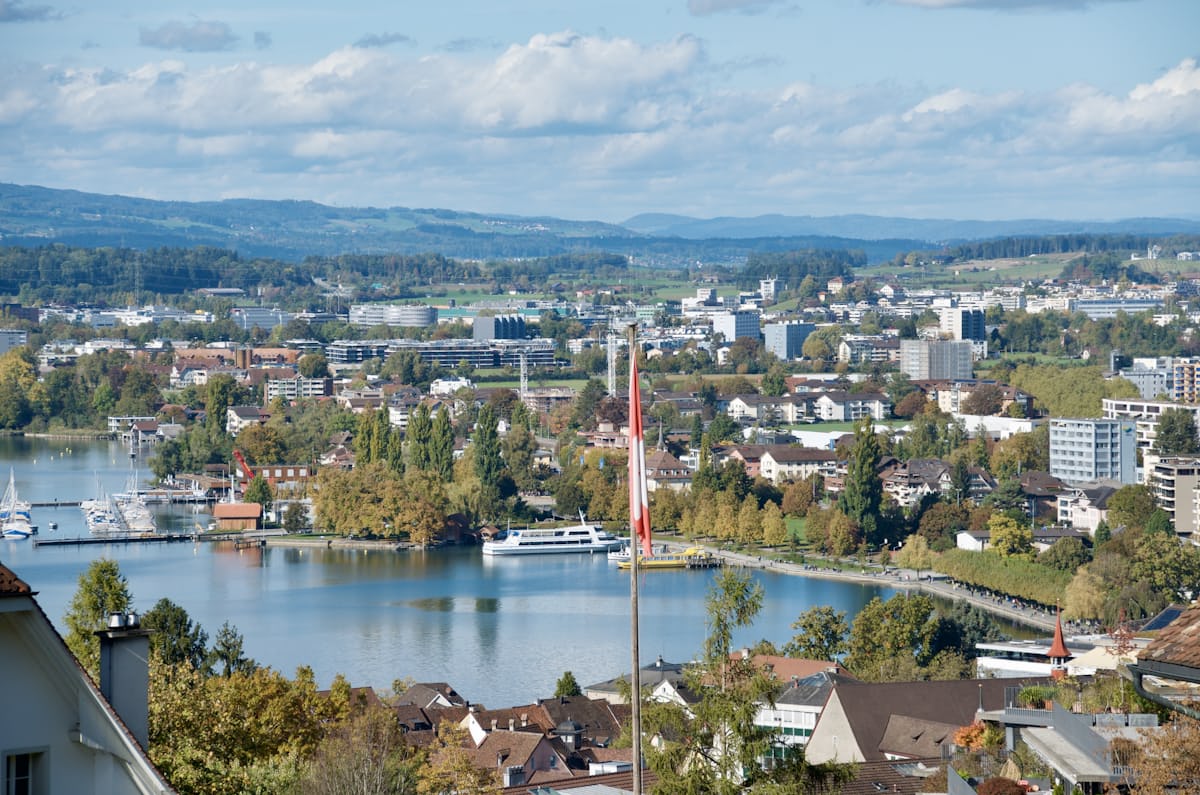
Most people arrive in Zug expecting something that looks like a crypto trading floor or a Silicon Valley campus. What they find instead is a medieval old town, a very still lake, and a small city of about 30,000 people where nothing immediately signals “world’s crypto capital.”
The density is real. It’s just not visible until you know where to walk.
This is a geographic field note — a slow walk through the six streets that contain the bulk of Zug’s crypto infrastructure, from the VC funds and incubators to the law firms that drafted the first blockchain foundations, to the cafes where the actual deals happen over flat whites on Tuesday mornings.
1. Dammstrasse: The Heartbeat of the Valley
If you could only walk one street in Zug to understand Crypto Valley, it’s Dammstrasse. Number 16 is the address that most insiders would tell you first: CV VC and CV Labs occupy the building, making it the closest thing Zug has to a crypto campus.
CV VC is one of the most active blockchain-focused venture funds in Europe — the firm behind the widely-cited annual Crypto Valley Top 50 report. CV Labs runs the co-working operation underneath, a flexible workspace that has hosted early-stage founders from across the ecosystem. The incubator structure has been involved in some remarkable history: the Tezos ICO in 2017, which raised $232 million, was coordinated partly through this address.
The building also houses the SHED Club, an exclusive members-only space that opened in 2021 with a restaurant and private meeting rooms. It’s the kind of place that doesn’t advertise itself, which is characteristic of how Zug’s more significant transactions tend to work.
Dammstrasse sits roughly parallel to the main train station and about three minutes on foot from Bahnhofplatz. The proximity to the Zug Bahnhof matters — the station connects to Zürich in under 30 minutes, which means investors and founders can do a morning meeting in Zug and be back in Zürich for lunch.
Walk this street if you want to: understand the VC and co-working layer of the ecosystem. Founders looking for desk space or warm introductions to the CV network will find Dammstrasse the most practical entry point.
2. Gubelstrasse: Where the Legal Architecture Was Built
Gubelstrasse doesn’t look like a historic street. It’s largely residential and commercial, a slightly quieter corridor that rises north from the old town toward the hills. But number 22 contains some of the most consequential square meters in crypto history.
MME Legal, the law firm that established the Ethereum Foundation on February 1, 2014, operates out of this address. Luka Müller and the MME team structured the foundation model that Vitalik Buterin and the Ethereum co-founders used to legally organize the project — the first blockchain foundation of its kind. Almost every major Swiss blockchain foundation that followed used the same template. If you want to understand why Switzerland became the go-to jurisdiction for token foundations, the story starts at Gubelstrasse 22.
The Zug city administration (Stadtverwaltung) also operates from nearby. In 2016, Zug became the first city in the world to accept bitcoin for administrative fees — a symbolic gesture that nonetheless broadcast a clear signal about the canton’s regulatory intentions.
Gubelstrasse is not a deal-making street so much as a legal infrastructure street. The real estate here is law firms and compliance consultants, not founders pitching products. If your business needs a Swiss legal structure — a foundation for token issuance, a VASP registration, or advice on FINMA’s current guidance — this is where you’ll have those conversations.
Walk this street if you want to: understand the compliance and legal layer. It’s the reason Zug has credibility as a jurisdiction, not just a tax-friendly address.
Relevant reading: MiCA vs FINMA: A Field Note from Someone Who Watches Both covers how Swiss legal frameworks compare to the EU approach.
3. Gotthardstrasse: The Business Corridor with Good Coffee
Gotthardstrasse connects the old town to the lake, running roughly north-south through one of Zug’s more active commercial corridors. Number 26 — the Lakeside Business Centre — has been a registered address for a surprising number of crypto names over the years: Consensys and Bitmain both have or had registered presences here, alongside Lakeside Partners and inacta AG.
Until October 2017, Lakeside Business Centre had one of the only public bitcoin ATMs in Zug, installed by Lamassu. It was stolen in the middle of the night by a single thief. The story says something about how early the ecosystem was at that point, and how casual the infrastructure still was.
The Speck Cafe, on the corner of Gotthardstrasse and Alpenstrasse, has become a reliable meeting spot for extended conversations — the kind that don’t quite fit into a 45-minute co-working room booking. Soups, salads, two floors, and enough noise that a fundraising conversation doesn’t carry across the room.
Gotthardstrasse is less of a single-company corridor and more of a mid-density commercial zone where advisory firms, consulting shops, and international companies with Swiss addresses concentrate. The energy here is quieter than Dammstrasse — fewer hoodies, more button-down shirts.
Walk this street if you want to: find the consulting and advisory layer. Companies providing infrastructure services to the ecosystem — legal, advisory, accounting — tend to cluster here.
4. Grafenauweg: Where the Old-Guard Crypto Finance Sits
Grafenauweg is a short business street running northeast from the Zug city center. Number 12 is Bitcoin Suisse’s current address — one of the earliest and most established crypto financial intermediaries in Switzerland.
Bitcoin Suisse was founded in 2013, making it one of the oldest crypto brokerages operating in Europe. It’s regulated under Swiss financial law and manages assets across crypto brokerage, custody, and staking. Before moving to Grafenauweg, Bitcoin Suisse spent years in an industrial zone, which reflects how the company grew alongside the ecosystem rather than being housed in premium real estate from the start.
A few doors down at Grafenauweg 6, Restaurant Meating was one of the first dining establishments in Zug to accept cryptocurrency as payment. It was a practical statement as much as a symbolic one — the founders of early crypto companies ate here, and the fact that payment could be settled in bitcoin was simply a convenience, not a novelty.
Grafenauweg has a quieter, slightly more institutional feel than Dammstrasse. The businesses here tend to be further along in their lifecycle — not pre-seed startups looking for a desk, but established financial service providers with AML compliance officers and client onboarding procedures.
Walk this street if you want to: understand the financial services layer of Crypto Valley. Bitcoin Suisse’s presence here anchors a cluster of adjacent financial intermediaries.
Relevant reading: What Getting a Crypto-Friendly Bank Account in Switzerland Actually Takes covers the actual process of accessing crypto-native banking in this environment.
5. Baarerstrasse: The Association District
Baarerstrasse runs parallel to the main train station area, about two minutes east of Dammstrasse. Number 8 is the registered address of the Crypto Valley Association (CVA), the non-profit body that functions as the ecosystem’s formal coordination layer.
The CVA has been operating since 2017, and its membership network includes over 850 crypto professionals and more than 250 corporate organizations. It organizes the annual Crypto Valley Conference, the largest blockchain event in Switzerland, and the networking events that give the ecosystem a calendar.
The CVA’s role here is less about deal-making and more about signal and legitimacy. Being a CVA member gives a company a visible affiliation with the Swiss crypto establishment. For foreign companies establishing a Swiss presence, the association provides a structured entry point into the ecosystem’s informal networks.
Baarerstrasse more broadly is a transitional zone — not quite the old town, not quite the industrial periphery. The buildings are newer and more functional than the historic center. Law firms and advisory groups share space with the kind of back-office operations that crypto companies need but rarely want to talk about publicly: corporate secretarial services, registered agent offices, trust companies.
Walk this street if you want to: connect with the institutional layer of the ecosystem and understand how the more formal networking functions.
6. Kolinplatz and the Old Town Core: Where the Deals Used to Happen (and Still Do)
Kolinplatz is the main square in Zug’s medieval old town, and it functions as the geographic and social center of the ecosystem’s informal layer. Number 15 on Kolinplatz is SEBA Bank (now rebranded as Amina Bank after the 2023 merger) — one of the two Swiss banks to receive a full banking license for crypto services in August 2019. That moment was significant: FINMA granting SEBA and Sygnum banking licenses within weeks of each other signaled that Switzerland intended to integrate crypto into regulated finance rather than tolerate it at the margins.
Hotel Ochsen at Kolinplatz 11 hosted some of the earliest Bitcoin meetups in Zug, starting in 2014. These gatherings were small — a few dozen people at most — but they formed the initial network from which much of Crypto Valley’s social infrastructure grew.
The Starbucks in the Metalli shopping center, near Bahnhofstrasse, became one of the most unlikely recurring venues in the ecosystem. Multiple people have described it as an informal epicenter of crypto meetings — not because it’s a particularly good space for business, but because it’s steps from the train station and open at hours when other venues are not. The who’s-who of Crypto Valley has been spotted here, at tables that wouldn’t look out of place in any other city.
The old town itself — Kolinplatz, the streets around the Stadthaus, the lake promenade — is where Zug’s historic character intersects with its crypto identity. The Seepromenade is where the Ethereum Foundation reportedly paid its first salaries in cryptocurrency in 2014, which is either deeply significant or a good piece of local mythology, depending on your tolerance for origin stories.
Walk this area if you want to: understand the social history of the ecosystem and access the informal networking layer that still operates through bars, restaurants, and chance encounters.
Relevant reading: Using Crypto Day-to-Day in Zug: What Actually Works covers what it’s like to actually spend crypto in this city.
The Afternoon Walk Route
If you want to cover all six areas in a single afternoon, the route is about 3 kilometers and takes roughly 90 minutes at a comfortable pace, with time to pause.
Start at CV Labs on Dammstrasse 16 — check the schedule if you want to catch a public event or use the co-working space. Walk five minutes south to Grafenauweg and the Bitcoin Suisse neighborhood. From there, cut through the business district toward Gotthardstrasse, where Speck Cafe makes a sensible stop.
Head toward the old town and Kolinplatz, passing Amina Bank and the Hotel Ochsen. Walk the Seepromenade along the lake — it takes you from the old town toward the southern waterfront and back. From the promenade, cut up through the hillside streets toward Gubelstrasse, where MME’s offices are. Finish back at Baarerstrasse and the CVA.
The whole walk is small enough that you’ll feel the compactness immediately. Crypto Valley’s geographic footprint in Zug is genuinely modest. It’s not spread across districts or neighborhoods — it’s concentrated in a few hundred meters of a small Swiss city, which is part of what makes the network effects possible.
What the Geography Tells You
The clustering matters for a reason beyond convenience. When CV Labs, CVA, MME Legal, Bitcoin Suisse, and Amina Bank are all within a ten-minute walk of each other, the friction for introductions drops significantly.
A founder who is a CV Labs co-working member is a short walk from the CVA events calendar, a legal introduction to MME, a banking conversation with Amina, and an informal dinner where at any given table someone holds a fund or an exchange or a project that might be relevant.
This geographic density is what distinguishes Zug from other crypto hubs. Dubai has more capital. Singapore has stronger institutional finance. London has more regulatory sophistication. But very few places pack this level of specialized infrastructure into this small a footprint, with this level of relationship density between the people who work there.
The streets don’t explain Crypto Valley. But walking them in order gives you a map of how the pieces connect — which is a useful thing to have before the meetings start.
For more on the Crypto Valley ecosystem, see the Crypto Valley 2026 Snapshot and CV Labs and the Zug Co-working Scene. On the regulatory framework underlying all of this, FINMA’s Crypto Guidance 01/2026 and Why Ethereum Was Born in Zug provide relevant context.